Kaifeng Sida Agricultural Products Equipment Co.,Ltd. Century Enterprises Bureau Veritas Certified European Craftsmanship
Contact No.:+86 18438491113
Email:sida@cnstarchmachine.com
Contact No.:+86 18438491113
Email:sida@cnstarchmachine.com
Adr : Huanglong garden in Kaifeng Economic Development Zone, Henan
Phone : +86 18438491113
Email : sida@cnstarchmachine.com
Tel : +86 371-26630769
When choosing a manufacturer of complete sets of equipment for kudzu root potato and cassava starch production line, the following three aspects need to be examined: 1. 1. The years of service of the potato starch equipment manufacturer, 2. The adopted process of the potato starch equipment manufacturer, 3. The main research directions of potato starch equipment manufacturers, etc
I. Investigation Dimension 1: The years of operation and comprehensive strength of the potato starch equipment manufacturer
The years of operation cannot be solely determined by the registration time of the business license. It is necessary to break down the verification into three layers: the actual years of operation, the duration of project implementation and existence, and the production and supporting capacity of the factory, to distinguish between "trade middlemen" and physical equipment manufacturers.
1. Stratified judgment criteria based on years of service
1) 1-3 years of experience: Start-up small factories:
2) 5 to 10 years of experience: Medium-sized physical manufacturers usually have successful cases of small and medium-sized sweet potato and potato starch production lines, and the basic wet starch process is mature.
3) A professional equipment factory with over 10 years of experience: covering all types of potato starch production lines including sweet potatoes, potatoes, cassava, and kudzu root. We have complete line implementation project cases, suitable processing techniques for different raw materials, and stable after-sales and on-site installation and commissioning teams.
Supporting verification (Distinguishing genuine from fake established factories
Verify the qualifications of past project contracts, on-site photos of the factory area, and on-site visits to the customer's factory area.
Many manufacturers have been established for over a decade, but they initially focused on feed machinery and agricultural machinery. It was only in the last two years that they switched to making starch equipment, lacking practical experience.
Factory scale: The factory has its own steel plate processing workshop, CNC bending workshop and tank welding workshop as the physical factory. There are no self-owned workshops and all processing is outsourced by middlemen, so the quality of the equipment is uncontrollable.
Ii. Overall Process Flow (Common basic route for all three, and differentiated selection of equipment for each section as needed)
Raw material pretreatment → multi-stage cleaning and stone removal → crushing and grinding → slurry and residue separation → multi-stage cyclone purification (protein/fiber/sand and mud removal) → vacuum dewatering → air flow drying → screening into products → automatic packaging
Ii. Selection of Core Equipment for Each Section (Divided into general models + Specific Differences for Cassava/Potato/Sweet Potato)
(1) Raw material conveying and cleaning section (The first key step, the form of raw materials determines the machine type)
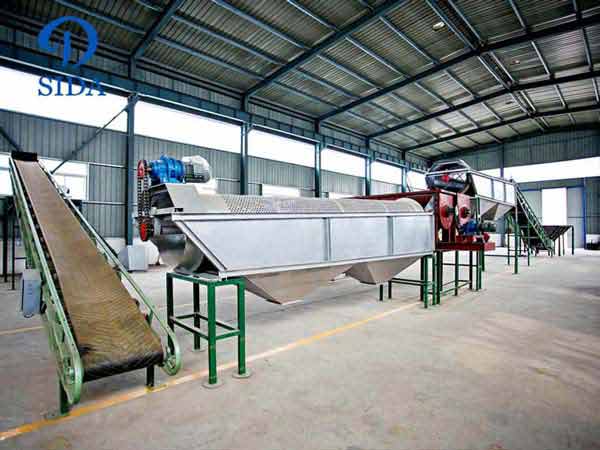
Dry cleaning and impurity removal machine (General front-mounted)
Selection criteria
Small line (≤5t/h) : Drum dry screen, removing straw, stones and large pieces of soil;
Medium and large-sized lines (≥10t/h) : Vibrating dry cleaning classification screen with air separation.
General material: 304 stainless steel in contact with materials, carbon steel with anti-corrosion treatment for the frame.
2. Clean the main unit (Core differences among the three)
Cassava paddle type cleaning machine: Long cassava strips, thick skin, and deep mud and sand embedding. Strong rubbing and peeling, less prone to material breakage and machine clogging. Extended body, wear-resistant blades, high-pressure spray, and equipped at the tail end
Potato (potato) matching squirrel-cage drum washing machine: The skin of potatoes is thin and starch is prone to loss. Flexible rolling cleaning, low skin breaking rate, fine roller gaps, low-speed rotation, and reduced starch loss
Sweet potato (sweet potato) two-stage cleaning with drum and paddle: Sweet potatoes have a lot of fibers and are prone to skin breakage and oxidation. First, perform a rough wash on the drum and a deep clean wash on the blades. Add a color-protecting spray to prevent Browning
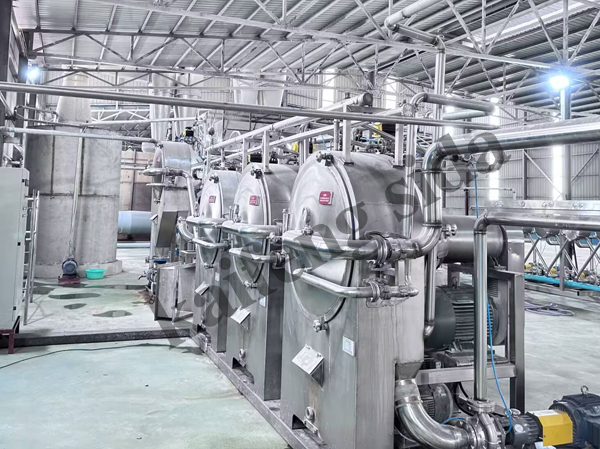
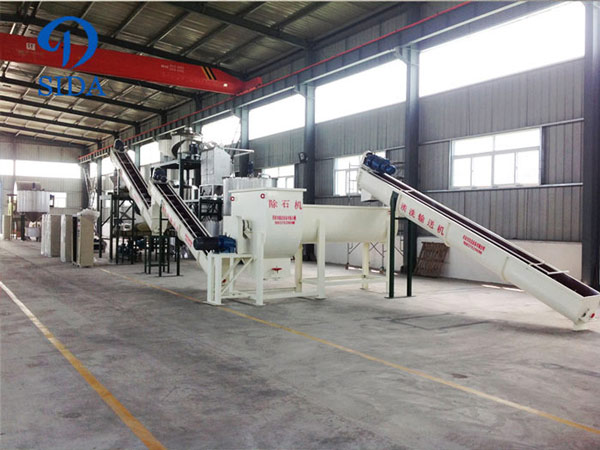
3. Auxiliary facilities: Screw elevator, hydraulic stone remover
Cassava noodles must be equipped with a powerful stone remover: cassava is dug with a lot of sand and stones.
Sweet potato noodles with buffer silo: Sweet potatoes are fragile, so avoid squeezing and damaging them when feeding.
(2) Crushing, filing and grinding section (Determining starch extraction rate, differentiated selection of raw material fibers/hardness)
High-speed grinding machine is suitable for: potatoes, cassava, sweet potatoes, and is a standard configuration for food-grade refined starch.
(3) Slurry and Residue Separation Section (Separating starch milk from fiber residue)
Sweet potato: Double-layer sieve, coarse sieve for removing coarse fibers, fine sieve for filtering starch;
Potato: Single-layer fine sieve, large starch particles, anti-filter penetration;
Cassava: Wear-resistant polyurethane screen plates, with strong wear resistance of wood fibers.
Small-scale alternatives: inclined screens, vibrating filter screens
For simple lines with a daily processing capacity of less than 3 tons, the sludge discharge is incomplete and the starch loss is high.
Slag recovery: Screw slag extruder, squeezing the residual starch in the slag to increase the yield.
(4) Cyclone purification Section (Determining the purity and whiteness of starch, the core of the entire line)
Multi-stage cyclone station (general, but with different stages and layouts)
Potato starch: 18-stage cyclone unit
Potatoes have a high protein content. Multi-stage countercurrent washing removes cell SAP and protein, resulting in a high viscosity of the finished product.
Sweet potato starch: 18-stage cyclone + color protection system
Sweet potato polyphenols are prone to oxidation. The cyclone operates at a low temperature throughout the process, and is equipped with desulfurization and decolorization branch circuits. Ash content control: ≤0.3%.
Cassava starch: 18-stage cyclone station
Cassava has a low protein content and mainly removes sediment and fine fibers. Industrial starch can be simplified to grade 6, and edible grade is grade 8.
(V) Dehydration Section (Wet starch dehydration, moisture content controlled at 38%-42% before entering the drying process)
Vacuum belt dewatering machine (standard configuration for medium and large fully automatic lines) : Continuous discharge, stable moisture content, high degree of automation;
Cassava noodles can be equipped with a horizontal screw sedimentation centrifuge: the raw materials have many impurities and pre-concentrated starch milk.
(6) Drying Section (Dry starch moisture content ≤13%, national standard)
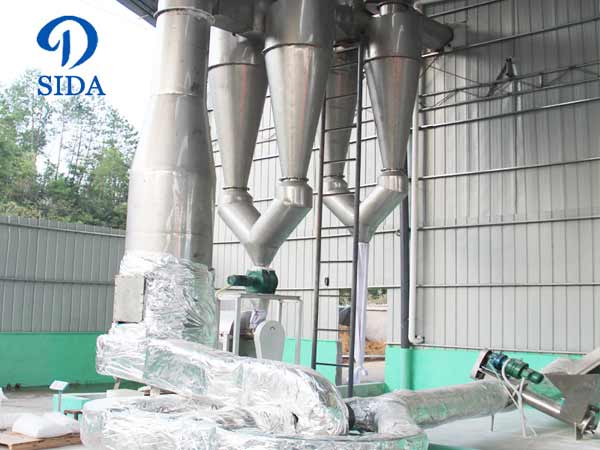
Air flow pulse dryer
General selection rule: Capacity matches the front-end fresh potato processing volume;
Fine-tuning of raw materials
Large potato starch granules: Extend the drying pipeline, dry at low temperature and slow speed to prevent granule breakage.
Fine sweet potato/cassava starch granules: Shorten retention time and prevent charring and yellowing.
Supporting facilities: Hot blast stove (biomass/natural gas dual-fuel environmentally friendly model), cyclone dust removal for fine powder recovery, reducing losses.
(7) Post-treatment section (General, no raw material differences)
Vibrating fine screening machine: 200-mesh classification, removal of lumps;
Automatic quantitative packaging machine: 25kg/50kg bagged, PLC weighing;
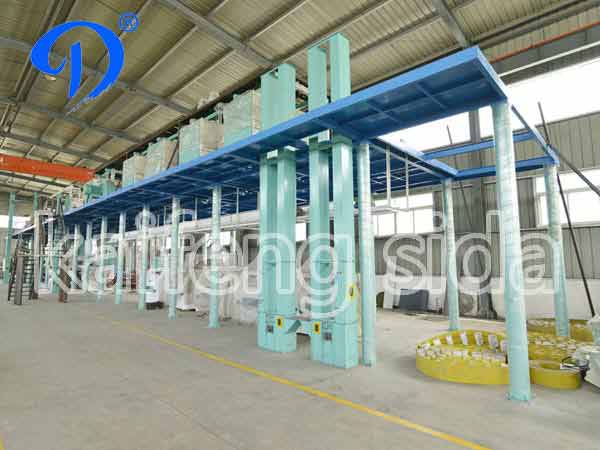
Auxiliary: Finished product storage warehouse, dust removal system, PLC centralized control cabinet.
Iii. Complete Set Selection Scheme by Production Scale Classification (with fresh potato processing capacity as the standard
Small-scale production line (1 to 4 tons of fresh potatoes per hour, processing 10 to 30 tons per day)
Applicable: Farmers, small processing plants in towns and townships, with low budgets;
Configuration: Dry cleaning machine + single-stage cleaning + hammer crushing + circular screen + cyclone group + vacuum dewatering machine + small-scale air flow drying;
2. Medium-sized fully automatic production line (5 to 15 tons of fresh potatoes per hour, processing 50 to 150 tons per day)
Standard configuration: Two-stage cleaning + high-speed file grinding machine + horizontal centrifugal screen + 18-stage cyclone station + vacuum dehydration + pulse air flow drying + automatic packaging + PLC central control;
Multi-functional in one machine: Replace and clean the blades/rollers, adjust the number of swirl stages
3. Large-scale industrial production lines (20 to 50 tons of fresh potatoes per hour, with a daily processing capacity of over 200 tons)
Applicable to large-scale planting bases and starch deep processing enterprises (supporting for modified starch and vermicelli factories);
Upgrade configuration
Potato noodles: Add dish protein separator and starch classification cyclone;
Sweet potato line: Fully automatic color protection and desulfurization system, continuous residue extrusion and recovery;
Cassava thread: Extended powerful cleaning and peeling unit, multi-stage sand removal;
Supporting facilities: Integrated wastewater pretreatment, closed dust-free workshop, remote intelligent control system;
Investment: million-level, 24-hour continuous operation, high per capita production capacity
All rights reserved:Kaifeng Sida Agricultural Products Equipment Co.,L SitemapSitemappSitemapsupport:dian zi